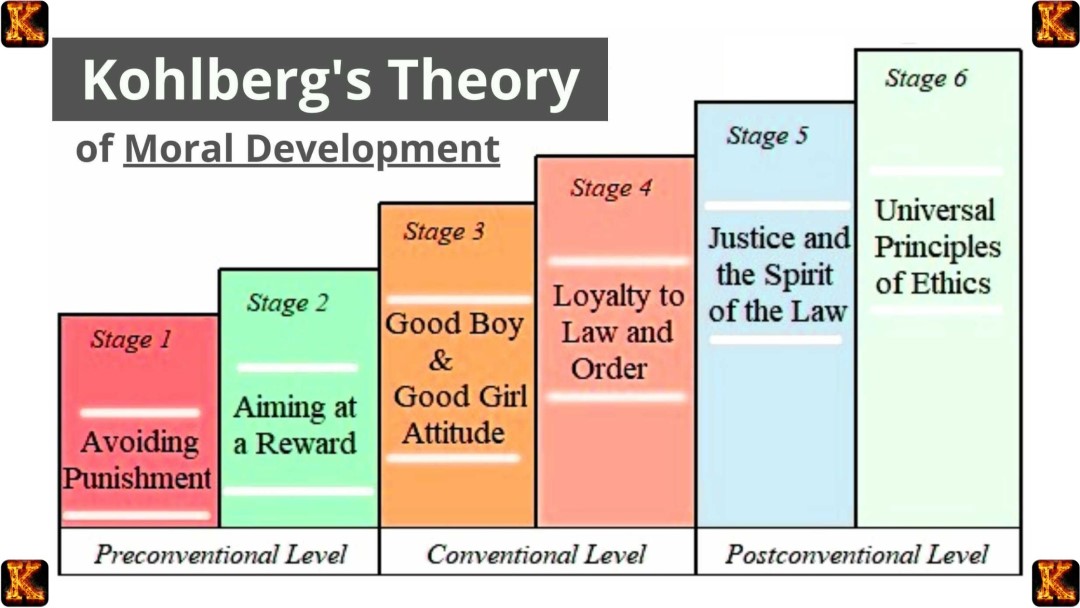
Kohlberg's Theory of Moral Development
Overview of the Theory
Kohlberg's theory of moral development explains how moral reasoning progresses through a structured sequence of stages that are considered universal across cultures. The theory focuses on how individuals think about moral issues rather than how they behave in specific situations. According to Lawrence Kohlberg, moral development involves qualitative changes in reasoning. This means that as children grow, they do not simply learn more rules. Instead, they develop more complex ways of justifying what is right and wrong.
Moral reasoning begins with a strong reliance on external authority such as parents, teachers, and social rules. Over time, individuals may develop the ability to evaluate these rules critically and form their own ethical principles. This progression reflects a shift from externally controlled thinking toward internally guided moral judgment.
Sequential Nature of Moral Development
A central assumption of Kohlberg theory of moral development is that moral reasoning develops in a fixed order. Individuals must pass through earlier stages before reaching more advanced ones. Movement between stages is influenced by cognitive growth, social interaction, and exposure to moral challenges.
At lower stages, moral decisions are typically based on avoiding punishment or gaining rewards. At intermediate stages, individuals begin to value social approval and the importance of maintaining order within society. At higher stages, moral reasoning becomes based on broader ethical principles such as justice, fairness, and respect for human rights. Not all individuals reach the highest stages because they require advanced abstract thinking and reflective judgment.
Focus on Moral Justification Rather Than Behaviour
Kohlberg emphasized that the reasoning behind a moral decision is more important than the decision itself. Two individuals may perform the same action for very different reasons. For example, one person may follow a rule because they fear punishment, while another follows it because they believe it contributes to social stability. Although the behaviour appears identical, the underlying moral reasoning reflects different stages of development.
This distinction allows researchers and educators to better understand how moral thinking evolves and why moral disagreements occur. It also highlights that true moral development involves changes in cognitive structure rather than simple behavioural conformity.
Research Method and Use of Moral Dilemmas
Kohlberg developed his theory by presenting participants of different ages with hypothetical moral dilemmas. One well known example involves deciding whether it is acceptable to break the law in order to save a loved one’s life. Instead of judging responses as correct or incorrect, he analysed how participants justified their decisions.
Through this method, he identified consistent patterns in moral reasoning across developmental stages. Younger children tended to focus on punishment or personal benefit, while older individuals considered social expectations or universal ethical values. This research approach provided empirical support for the idea that moral reasoning evolves alongside cognitive development and social experience.
Developmental Significance
The theory has important implications for education and socialization. It suggests that moral growth can be supported by encouraging discussion, perspective taking, and exposure to complex ethical situations. As children interact with peers and authority figures, they are challenged to reconsider their assumptions about fairness, responsibility, and justice.
In this way, Kohlberg's theory of moral Development provides a framework for understanding how individuals move from simple rule following in childhood toward principled moral thinking in later life.
Read Also: Biopsychosocial vs Cognitive Approaches in NPD Evaluation
The Six Stages of Kohlberg's Stages of Moral Development
Structure of the Stages
In Kohlberg's theory of moral development, moral reasoning progresses through six distinct stages that are organized into three broader levels. These stages describe how individuals justify moral decisions from childhood into adulthood. Although some sources incorrectly refer to seven stages or steps, the framework proposed by Lawrence Kohlberg clearly identifies six stages. Each stage represents a more advanced way of thinking about rules, responsibility, and ethical principles.
Preconventional Level
The preconventional level is most commonly observed in early childhood. At this level, moral reasoning is centered on personal consequences rather than shared social values. Children interpret right and wrong mainly in terms of punishment, reward, or immediate personal benefit.
Stage One Obedience and Punishment Orientation
At this stage, children obey rules primarily to avoid punishment. Authority figures such as parents or teachers are seen as the source of moral standards. Actions are judged as wrong if they result in negative consequences. Moral reasoning is therefore externally controlled and focused on compliance.
Stage Two Instrumental Purpose Orientation
In the second stage, children begin to recognize that different individuals have their own needs and desires. Moral decisions are guided by self interest and reciprocal benefit. A child may behave cooperatively because they expect a reward or favor in return. This stage reflects an early understanding of fairness, but fairness is interpreted as equal exchange rather than as a broader ethical principle.
Conventional Level
The conventional level typically emerges during middle childhood and continues into adolescence. Moral reasoning becomes more socially oriented, and individuals begin to value relationships, expectations, and the maintenance of social order.
Stage Three Good Interpersonal Relationships Orientation
At this stage, individuals aim to be perceived as good, trustworthy, and considerate by others. Moral decisions are influenced by the desire for approval from peers, family members, and teachers. Empathy and perspective taking become more developed, allowing children to consider how their actions affect others. Conformity to social expectations is viewed as morally desirable.
Stage Four Maintaining Social Order Orientation
Stage four involves a stronger respect for authority, laws, and established rules. Individuals believe that social systems function effectively when rules are followed. Moral reasoning is based on duty, responsibility, and the importance of preserving order within society. Actions are judged according to whether they contribute to stability and collective well being.
Postconventional Level
The postconventional level represents the most advanced form of moral reasoning and typically develops later in adolescence or adulthood. Not all individuals reach this level because it requires abstract thinking and critical reflection on societal values.
Stage Five Social Contract Orientation
At this stage, individuals recognize that laws are created by societies to promote fairness and protect rights. Moral reasoning becomes more flexible, and people understand that rules can be challenged or changed when they conflict with fundamental principles. Ethical decisions are guided by an awareness of social welfare and individual freedoms.
Stage Six Universal Ethical Principles Orientation
The final stage involves reasoning based on deeply held moral principles such as justice, equality, and respect for human dignity. Individuals at this stage are willing to uphold these principles even when they conflict with laws or social expectations. Moral judgment becomes internally guided and consistent across situations. This stage reflects a commitment to ethical integrity rather than simple rule compliance.
Developmental Progression
Together, these six stages illustrate how moral reasoning evolves from simple obedience in childhood to principled ethical thinking in later life. The progression highlights the role of cognitive maturity, social interaction, and exposure to moral dilemmas in shaping how individuals understand and justify their moral choices.
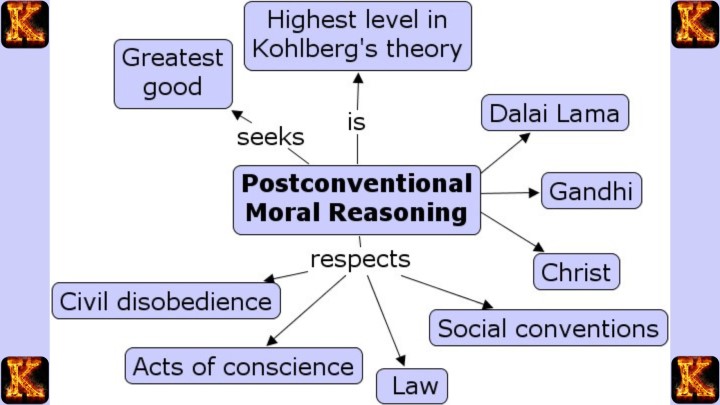
Kohlberg's Stages of Moral Development Ages
Absence of Fixed Age Boundaries
In Kohlberg's theory of moral development, stages are not tied to rigid age limits. Lawrence Kohlberg emphasized that moral reasoning develops through experience, cognitive growth, and social interaction rather than through biological age alone. This means that individuals may reach certain stages earlier or later depending on their learning environment, educational exposure, and opportunities to engage in moral discussion.
Although there are no precise age assignments, researchers and educators have observed general developmental patterns that help explain how moral reasoning typically evolves from childhood into adulthood.
Preconventional Reasoning in Early Childhood
Preconventional moral reasoning is most common during early childhood. At this stage, children tend to interpret right and wrong in terms of immediate consequences. Moral decisions are guided by the desire to avoid punishment or obtain rewards. Authority figures such as parents and teachers play a central role in shaping behaviour because children rely heavily on external guidance.
This form of reasoning reflects limited perspective taking and a focus on personal outcomes. Children may follow rules without fully understanding their broader social purpose. However, these early experiences form the foundation for more advanced moral thinking later in development.
Conventional Reasoning During Middle Childhood and Adolescence
Conventional moral reasoning becomes more prominent during middle childhood and continues to develop through adolescence. As children grow older, they become increasingly aware of social expectations, relationships, and the importance of maintaining order within groups such as families, schools, and communities.
At this stage, moral judgments are influenced by the desire to gain approval and to fulfill social roles responsibly. Children begin to understand that rules are necessary for cooperation and fairness. Their ability to consider the perspectives of peers and authority figures contributes to more socially oriented moral reasoning.
Postconventional Reasoning in Later Development
Postconventional reasoning usually emerges during adolescence or adulthood, although not all individuals reach this level. This stage requires advanced cognitive abilities such as abstract thinking, critical evaluation of social systems, and the capacity to reason about ethical principles independently.
Individuals functioning at this level recognize that laws and norms are created by societies and may be challenged when they conflict with fundamental values such as justice or human rights. Moral reasoning becomes internally guided rather than externally imposed. This shift reflects a deeper level of ethical reflection and personal responsibility.
Relationship Between Cognitive Growth and Moral Development
The progression through Kohlberg’s stages illustrates the close connection between cognitive development and moral reasoning. As children acquire logical thinking skills, develop metacognitive awareness, and learn to evaluate complex situations, they become better equipped to make nuanced moral judgments.
Exposure to diverse viewpoints, moral dilemmas, and cooperative social experiences further supports this development. Over time, individuals move from simple rule following toward a more principled understanding of fairness, responsibility, and ethical decision making.
Read Also: Applied Behavior Analysis in Clinical Psychology
Difference Between Kohlberg and Piaget
Foundations of Moral Development Theory
The study of moral development was significantly shaped by the work of Jean Piaget and later expanded by Lawrence Kohlberg. Both theorists were interested in how children come to understand rules, fairness, and responsibility. However, they differed in the scope of their explanations and the methods they used to study moral reasoning.
Piaget provided one of the earliest systematic accounts of moral development in childhood. His work focused on how children’s understanding of rules changes as their cognitive abilities mature. Kohlberg built on this foundation by proposing a more detailed stage based model that extends moral development into adolescence and adulthood.
Piaget’s View of Moral Development
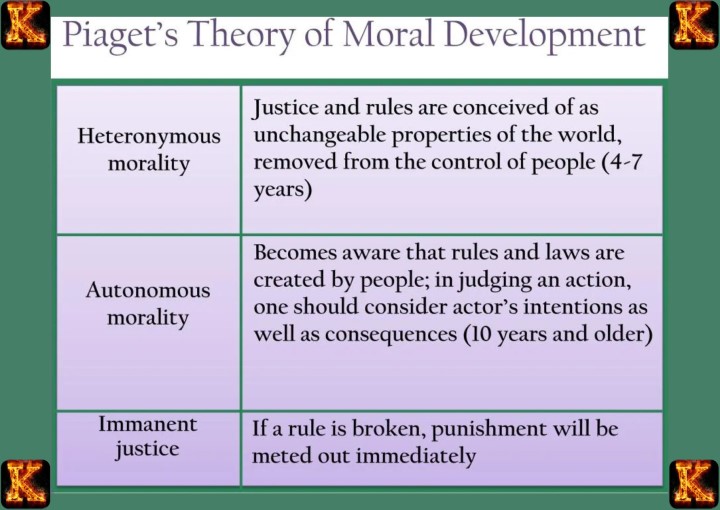
Piaget suggested that children move through two main phases of moral understanding. The first phase is moral realism. During this period, children see rules as fixed, absolute, and imposed by authority figures such as parents or teachers. They tend to judge actions based on outcomes rather than intentions. For example, a child may believe that accidentally breaking several objects is worse than intentionally breaking one object because the damage appears greater.
The second phase is autonomous morality. At this stage, children begin to recognize that rules are created through social agreement and can be modified. They also develop a better understanding of intentions and fairness. Moral reasoning becomes more flexible and cooperative as children interact with peers and negotiate shared expectations.
Kohlberg’s Expansion of Moral Reasoning
Kohlberg extended Piaget’s ideas by proposing that moral reasoning develops through six stages organized into three levels. His theory emphasized that moral development continues beyond childhood and becomes increasingly abstract. Instead of focusing mainly on how children understand rules, Kohlberg examined how individuals justify moral decisions across different contexts.
He introduced the use of ethical dilemmas as a research method to explore the reasoning process behind moral judgments. This approach allowed him to identify distinct patterns in how people think about justice, authority, and ethical responsibility at different points in development.
Key Differences in Focus and Method
One major difference between the two theorists lies in their emphasis. Piaget highlighted the role of cognitive readiness and peer interaction in shaping moral understanding. He believed that social experiences such as cooperation and conflict resolution help children move toward more mature moral thinking.
Kohlberg, in contrast, focused on the structure of moral reasoning itself. He was less concerned with specific behaviours and more interested in the logic individuals use when explaining their moral choices. His stage model provides a more detailed progression and includes higher levels of reasoning that involve evaluating laws and ethical principles critically.
Developmental Scope and Implications
Another important distinction is the developmental scope of their theories. Piaget’s framework primarily addresses moral development during childhood. Kohlberg’s model spans a broader portion of the lifespan and explains how moral reasoning can evolve into principled thinking during adolescence and adulthood.
Together, the contributions of Piaget and Kohlberg provide a comprehensive understanding of how moral judgment develops. Piaget explains the early transformation in children’s perception of rules and fairness, while Kohlberg offers a structured account of how moral reasoning continues to mature and become more ethically grounded over time.
Critiques and Gilligan's Theory of Moral Development
Limitations of Kohlberg’s Model
Although Kohlberg's theory of moral development has been highly influential in developmental psychology, it has also received important criticism. Scholars have questioned whether the stage model fully captures the diversity of moral reasoning across different cultures, social contexts, and life experiences. Some researchers argue that the theory places strong emphasis on individual rights, justice, and logical consistency while giving less attention to emotional factors and interpersonal responsibilities.
Another concern relates to the assumption that moral development follows a universal sequence. Evidence from cross cultural studies suggests that moral priorities and ethical reasoning styles may vary depending on social values, community expectations, and educational opportunities. These critiques encouraged psychologists to explore alternative perspectives that broaden the understanding of moral growth.
Gilligan’s Care Oriented Perspective
A major contribution to this discussion came from Carol Gilligan, who proposed Gilligan's theory of moral development. Gilligan argued that Kohlberg’s framework focused heavily on justice based reasoning, which emphasizes rules, rights, and fairness. In contrast, she highlighted a care based approach to morality that centers on empathy, relationships, and responsibility toward others.
According to this perspective, moral reasoning is not only about applying abstract ethical principles but also about maintaining connections and responding to the needs of people within specific social contexts. Decisions are often guided by concern for harm prevention, cooperation, and mutual support rather than by strict rule evaluation.
Gender and Cultural Considerations
Gilligan’s critique also raised questions about how gender socialization may influence moral development. She suggested that traditional research methods might have undervalued reasoning patterns that prioritize care and relational understanding. This argument contributed to wider debates about whether moral development theories should account for multiple pathways rather than a single hierarchical progression.
Furthermore, cultural influences play a significant role in shaping moral priorities. Societies that emphasize collective responsibility or community harmony may encourage reasoning styles that differ from those highlighted in stage based justice frameworks. Recognizing these variations helps educators and psychologists appreciate the complexity of moral development across diverse populations.
Broader Impact on Developmental Psychology
The dialogue between Kohlberg’s and Gilligan’s perspectives has enriched the study of moral reasoning. Rather than replacing one theory with another, contemporary research often integrates insights from both approaches. Justice oriented reasoning and care oriented reasoning are now seen as complementary dimensions that contribute to ethical decision making.
This expanded understanding highlights that moral development involves cognitive growth, emotional sensitivity, and social experience. By examining different theoretical viewpoints, students gain a more comprehensive appreciation of how individuals learn to evaluate moral issues and navigate complex ethical situations throughout life.

Conclusion
The evolution of moral reasoning since childhood reflects the interaction between cognitive growth, social experience, and ethical reflection. Kohlberg theory of moral development remains a foundational framework for understanding how individuals move from rule obedience toward principled moral thinking. Although not all individuals reach the highest stages, the theory highlights the importance of education, dialogue, and exposure to moral challenges in shaping ethical maturity. Understanding these developmental processes helps students, educators, and psychologists appreciate how moral judgment develops across the lifespan and why moral disagreements often reflect differences in reasoning rather than differences in values alone.