Introduction
Neoliberal capitalism refers to an economic and political framework that prioritizes free markets, privatization, deregulation, and reduced state intervention in economic affairs. Emerging prominently in the late twentieth century, particularly through policy reforms in the United States, the United Kingdom, and international financial institutions, neoliberalism reshaped how economies operate both domestically and globally. It promotes competition, capital mobility, and market efficiency as the primary drivers of economic growth and development.
At the same time, growing economic inequality has become one of the most defining characteristics of the modern global economy. Across both developed and developing countries, wealth and income are increasingly concentrated among a small segment of the population, while large portions of society experience stagnating wages, limited access to essential services, and declining economic security. This widening gap is not accidental but closely linked to the structural logic of neoliberal economic systems.
This article argues that neoliberal capitalism does not merely coexist with inequality but actively depends on it. By prioritizing profit maximization, weakening labor protections, and reinforcing unequal power relations between nations, corporations, and workers, neoliberalism creates conditions in which inequality becomes a functional and enduring feature of the global economic order. Understanding this relationship is essential for critically evaluating contemporary economic systems and exploring more equitable alternatives.

What Is Neoliberal Capitalism?
Neoliberal capitalism refers to an economic and political framework that gained dominance in the late twentieth century, particularly from the 1970s onward. It emerged as a response to economic stagnation and inflation in Western economies and was strongly promoted by political leaders such as Ronald Reagan in the United States and Margaret Thatcher in the United Kingdom. International institutions including the International Monetary Fund (IMF) and the World Bank played a central role in globalizing neoliberal policies, especially in developing countries through loan conditions and structural adjustment programs.
Core Principles of Neoliberal Capitalism
Market Deregulation
Neoliberalism emphasizes reducing government oversight of markets. Regulations on finance, labor, and industry are minimized to allow market forces to operate freely. The assumption is that competition leads to efficiency, innovation, and economic growth. In practice, deregulation often increases corporate power and market concentration.
Privatization of Public Services
Public services such as healthcare, education, transportation, and utilities are transferred from state control to private ownership. The rationale is that private entities operate more efficiently than governments. However, privatization frequently leads to reduced access, higher costs, and unequal service delivery, particularly for low-income populations.
Reduction of State Welfare and Social Spending
Neoliberal policies promote reduced government spending on welfare programs, social protection, and public assistance. Social risks such as unemployment, illness, and poverty are increasingly treated as individual responsibilities rather than collective concerns. This shift weakens social safety nets and increases economic vulnerability.
Free Trade and Capital Mobility
Neoliberalism prioritizes open markets, free trade agreements, and the unrestricted movement of capital across borders. While this facilitates global investment and corporate expansion, it also exposes domestic economies to external shocks and intensifies competition between workers across countries, often driving down wages and labor standards.
Neoliberalism Compared to Other Economic Models
Difference from Classical Liberalism
Classical liberalism emphasized limited government and free markets but developed within a context of smaller-scale economies and less global integration. Neoliberalism extends these ideas into a highly globalized system, actively restructuring states to serve market interests rather than merely limiting government intervention.
Difference from Welfare-State Capitalism
Welfare-state capitalism, common in the mid-twentieth century, combined market economies with strong social protections such as public healthcare, education, and labor rights. Neoliberalism departs from this model by prioritizing market efficiency over social equity and by reducing the role of the state in protecting citizens from economic risk.
Read Also: How Social Media Fuels Eating Disorder Risks
How Inequality Becomes a Feature, Not a Flaw
Under neoliberal capitalism, inequality is not an unintended outcome but a structural condition that supports economic accumulation and market efficiency. The system functions in ways that systematically advantage capital over labor and powerful actors over weaker ones.
Labor Market Dynamics
Wage Suppression
Neoliberal policies promote labor market flexibility, which often results in downward pressure on wages. Employers gain greater freedom to hire, fire, and outsource labor, reducing workers’ bargaining power. As a result, wage growth frequently fails to keep pace with productivity or the cost of living.
Labor Flexibility and Precarious Work
The rise of temporary contracts, gig work, and informal employment is a direct outcome of labor market deregulation. While presented as increasing efficiency and choice, flexible labor arrangements often produce job insecurity, limited benefits, and unstable income for workers.
Weakening of Labor Unions
Neoliberal reforms frequently restrict collective bargaining rights and weaken trade unions. With reduced union influence, workers lose an important mechanism for negotiating fair wages and working conditions, allowing employers to capture a larger share of economic gains.
Capital Concentration
Wealth Accumulation Among Corporations and Elites
Neoliberal systems encourage the concentration of wealth through tax policies, deregulation, and financial incentives that favor large corporations and high-income individuals. Over time, this leads to widening income and wealth gaps within and between countries.
Financialization of the Economy
Economic activity increasingly centers on financial markets rather than productive investment. Profits are generated through speculation, asset ownership, and debt rather than wages or manufacturing. This shift benefits financial institutions and investors while exposing workers and households to greater economic instability.
Unequal Bargaining Power
Corporations Versus Workers
Large corporations possess significant economic and political influence, enabling them to shape labor laws, tax policies, and trade agreements in their favor. Individual workers, lacking comparable leverage, are often compelled to accept unfavorable working conditions.
Global North Versus Global South
At the international level, inequality is reinforced through trade arrangements and global supply chains that favor wealthy nations. Developing countries often compete by offering cheap labor and weak regulations, locking them into low-value production roles while profits flow to multinational corporations headquartered in the Global North.
Global Inequality and the Developing World
Global inequality under neoliberal capitalism is most visible in the relationship between wealthy industrialized nations and developing economies. International financial institutions and global market structures often reinforce dependency rather than promote genuine development.
Structural Adjustment Programs (IMF and World Bank)
Structural Adjustment Programs introduced by the International Monetary Fund and the World Bank have played a central role in shaping economic policy in developing countries. These programs are typically imposed as conditions for loans and require governments to implement austerity measures, privatize state-owned enterprises, reduce public spending, and liberalize trade. While presented as necessary for economic stability, these policies frequently weaken public institutions, reduce access to essential services, and limit national economic sovereignty.
Debt Dependency and Austerity Measures
Many developing countries remain trapped in cycles of debt due to high interest payments and unfavorable loan conditions. Servicing external debt often takes priority over public investment in healthcare, education, and infrastructure. Austerity measures introduced to manage debt burdens reduce social spending and disproportionately affect low-income populations, deepening poverty and inequality rather than promoting long-term growth.
Extraction of Raw Materials and Cheap Labor
Global production systems rely heavily on the extraction of raw materials and low-cost labor from the developing world. Multinational corporations source minerals, agricultural products, and manufactured goods from regions with weak labor protections and minimal environmental regulation. This model generates profits for corporations and consumers in wealthier nations while limiting value addition and industrial development in resource-exporting countries.
Development That Reproduces Dependency
Rather than fostering economic independence, many development strategies reinforce dependency on foreign capital, technology, and markets. Developing economies often remain locked into low-value segments of global supply chains, with limited capacity to diversify or move up the value chain. As a result, development under neoliberal capitalism frequently reproduces existing global hierarchies instead of enabling sustainable and autonomous growth.
Read Also: Impact of Private Equity Acquisitions in Healthcare
The Role of Institutions and Policy
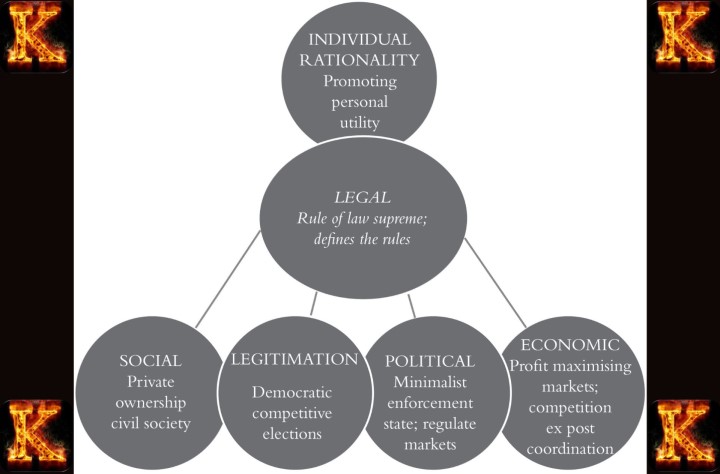
Institutions and policy frameworks play a central role in maintaining and reproducing inequality under neoliberal capitalism. Through legal structures, trade rules, and governance arrangements, economic power is often concentrated while public accountability is weakened.
International Trade Agreements and Investor Protections
International trade agreements increasingly prioritize investor rights over national sovereignty. These agreements often include investor protection clauses that allow corporations to challenge government regulations that may affect profits. As a result, governments may hesitate to introduce labor, health, or environmental policies for fear of legal and financial retaliation. This limits policy autonomy, particularly in developing countries that depend on foreign investment.
Weak Labor and Environmental Regulations
Neoliberal policy frameworks encourage deregulation as a strategy to attract investment and stimulate economic growth. Labor protections are often reduced, leading to low wages, insecure employment, and limited worker representation. Environmental regulations are also weakened, allowing resource extraction and industrial activity to proceed with minimal oversight. These practices externalize social and environmental costs while maximizing corporate profitability.
Influence of Multinational Corporations on National Policy
Multinational corporations exert significant influence over national policy through lobbying, political donations, and control over capital flows. Their economic power allows them to shape legislation related to taxation, trade, and regulation in ways that favor corporate interests. This influence often undermines democratic decision making and reduces the ability of governments to act in the public interest.
Erosion of State Capacity to Provide Public Goods
As governments reduce taxes on corporations and high-income groups, public revenue declines. Combined with privatization and austerity policies, this weakens the state’s capacity to provide essential public goods such as healthcare, education, housing, and infrastructure. Over time, the reduced role of the state deepens social inequality and increases reliance on market-based solutions that are often inaccessible to vulnerable populations.
Social Consequences of Inequality
The structural inequalities produced by neoliberal economic systems have far-reaching social consequences. These effects extend beyond income disparities and shape access to opportunity, political stability, and long-term social mobility.
Rising Income and Wealth Gaps
One of the most visible outcomes of neoliberal capitalism is the widening gap between the wealthy and the rest of society. Income growth is increasingly concentrated among high earners and corporate elites, while wages for middle- and low-income groups stagnate. Wealth accumulation through assets such as property, stocks, and financial instruments further deepens inequality, reinforcing class divisions across generations.
Reduced Access to Healthcare, Education, and Housing
As public services are privatized or underfunded, access to essential goods becomes increasingly dependent on income. Healthcare and education, once considered public rights in many societies, become market commodities available primarily to those who can afford them. Housing costs rise as real estate becomes a site of investment rather than social provision, contributing to homelessness, overcrowding, and urban inequality.
Political Instability and Democratic Erosion
High levels of inequality undermine democratic participation and trust in political institutions. When economic power becomes concentrated among elites, political influence often follows, marginalizing the voices of ordinary citizens. This imbalance can lead to voter disengagement, social unrest, and the rise of populist or authoritarian movements that exploit economic grievances.
Intergenerational Poverty and Limited Social Mobility
Inequality under neoliberal systems tends to reproduce itself across generations. Limited access to quality education, healthcare, and stable employment restricts upward mobility for disadvantaged groups. As opportunities become increasingly tied to family wealth and social background, social mobility declines, entrenching long-term poverty and reinforcing existing social hierarchies.
Together, these social consequences demonstrate that inequality under neoliberal capitalism is not merely an economic outcome but a structural condition that shapes life chances, social cohesion, and democratic stability.
Read Also: Company Description in Business Plan Assignment
Defending Neoliberalism and the Limits of Its Claims
Supporters of neoliberal capitalism often justify the system by emphasizing growth, efficiency, and innovation. However, empirical evidence shows that these claims do not adequately account for persistent inequality or uneven development outcomes.
The “Growth Will Trickle Down” Argument
A central justification for neoliberal policies is the idea that economic growth generated at the top will eventually benefit all segments of society. According to this view, wealth created by corporations and high-income earners will spread through job creation, investment, and consumption. In practice, however, economic gains have remained concentrated among elites, while wages for most workers stagnate and living costs continue to rise.
Claims of Efficiency and Innovation
Neoliberalism argues that market competition encourages efficiency, innovation, and productivity. While certain sectors have experienced technological advancement, these gains are often accompanied by job insecurity, automation-driven displacement, and cost-cutting measures that reduce labor protections. Efficiency gains frequently benefit shareholders more than workers or consumers.
Evidence of Unequal Distribution of Gains
Empirical data consistently show that economic growth under neoliberal systems has been unevenly distributed. In many countries, productivity has increased without corresponding wage growth. Wealth accumulation has become increasingly concentrated among corporations and high-income individuals, while public investment and social spending have declined.
Why Economic Growth Alone Does Not Equal Development
Economic growth does not automatically translate into improved living standards, social mobility, or human development. Development requires investment in health, education, infrastructure, and social protection. Without inclusive policies, growth can coexist with poverty, inequality, and social exclusion, revealing the limits of growth-centered economic models.
Read Also: Best Economics Essay Writing Service
Alternatives and Emerging Critiques
As the limitations of neoliberal capitalism become increasingly apparent, scholars and policymakers have proposed alternative economic models and reforms that prioritize equity, sustainability, and social well-being.
Inclusive and Sustainable Development Models
Inclusive development focuses on ensuring that economic growth benefits all segments of society, particularly marginalized and low-income groups. Sustainable development integrates environmental protection and social equity into economic planning. Together, these models aim to reduce inequality while promoting long-term economic and ecological resilience.
Social Democratic and Mixed-Economy Approaches
Social democratic and mixed-economy models combine market mechanisms with strong state intervention and social protection. These approaches emphasize universal healthcare, public education, labor rights, progressive taxation, and welfare programs. By balancing market efficiency with social equity, they aim to reduce income gaps and ensure more equitable access to essential services.
Strengthening Labor Protections and Public Investment
Enhanced labor protections, including minimum wage policies, collective bargaining rights, and workplace safety regulations, are essential to counter the negative effects of market deregulation. Increased public investment in healthcare, education, infrastructure, and social programs can provide a foundation for sustainable economic growth and reduce reliance on private markets for essential services.
Rethinking Economic Success Beyond GDP
Traditional measures of economic success, such as GDP growth, fail to capture social well-being, environmental health, and equality. Alternative indicators, including the Human Development Index, the Genuine Progress Indicator, and measures of social and environmental sustainability, provide a more holistic view of development. These metrics encourage policies that prioritize quality of life over mere financial growth.
Conclusion
Inequality is not an accidental outcome of neoliberal capitalism but a structural feature that sustains the system. Policies such as deregulation, privatization, labor market flexibility, and global trade arrangements systematically concentrate wealth and power while limiting social protections. Both within nations and across the global economy, these structures reinforce economic disparities and constrain opportunities for marginalized populations.
Understanding how economic systems operate and the mechanisms through which they produce inequality is essential for students and citizens alike. Critical engagement with these concepts allows for informed analysis of policy choices, economic outcomes, and their social consequences.
Moving forward, debates about economic models must prioritize human well-being, social equity, and sustainability alongside financial growth. Considering alternatives that balance market efficiency with public investment, labor protections, and inclusive development can help create economies that serve people rather than perpetuate inequality.
Comments are closed!